Showing posts with label Melbourne. Show all posts

Tuesday, June 28, 2011

Behaviour change

The next PBT seminar is on behaviour change. This article from the New York Times presents an interesting American perspective on the European trend to bring about mode shift through making driving a car too inconvenient or too costly.

some fantastic quotes and factoids from the article:


  • 'Our goal is to reconquer public space for pedestrians, not to make it easy for drivers'

  • 91% of delegates tot the Swiss parliament catch the tram to work.

  • 70% of Sihl City shopping mall in Zurich get there by public transport because it only has a sixth of the parking that an American shopping mall would have.

  • Pedestrianised streets in central Zurich saw a 30% to 40% increase in pedestrian traffic when cars were banned.

  • 'When I'm in other cities (outside Zurich) I always feel like I'm always waiting to cross a street. I can't get used to the idea that I am worth less than a car.'

Now compare it to a recent article in The Age where some retailers are bemoaning the impending closure of Swanston Street to traffic - part of the redevelopment of the street. Melbourne City Council are following the lead of European cities but are the retailers (and the media) willing to throw their weight behind 'reconquering public space for pedestrians'.


I look forward to seeing the outcomes of this brave and visionary political leadership.

Saturday, October 23, 2010

London cycle hire

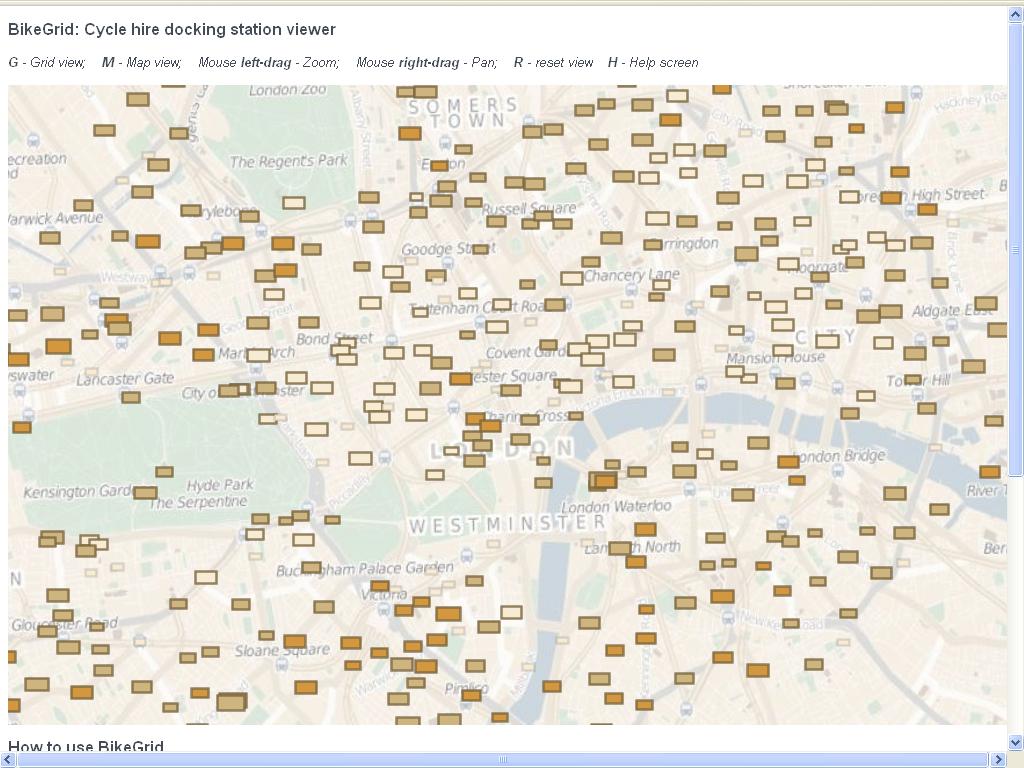
London's bike hire scheme - Barclays bike hire - have a website that gives real-time information on the availability of bikes/spaces at the different stations all across London. The first thing that struck me was the number of hire stations and bicycles scattered around central London. Quite incredible.

It is a little difficult to use at first but once you get the hang of it, it provides interesting information on the use of the scheme. If you go to the grid view - press G and the map morphs into a grid - you can zoom into each station and see what the use has been over the last 24 hours and how many bikes are there right now.
It is interesting to see how many stations have very strong fluctuations in use (like Hyde Park corner below) while others see limited use (like Knightsbridge). The timing in the peaks is also interesting and would appear to show the main direction in flows.
There is a wealth of information on how people move in the city that these bikeshare schemes can gather. I am sure there are a few doctoral theses that you could do on transport planning in inner cities using the information.

Brisbane's CityCycle scheme and Melbourne's Bike share scheme have real time maps (CityCycle map here, Melbourne map here) where you can get information on the number of bicycles or spaces available at any station. They don't give a history of use though so it is impossible to see a history of usage.

Interestingly the information in the CityCycle web site has a field 'credit cards accepted'. All the stations currently indicate that no credit cards are accepted, but this possibly points to this being a feature that can be added.

Saturday, October 16, 2010

Melbourne's helmet vending machines

Photo source: article by J Williams

Melbourne has just launched a 3 month trial of a helmet vending machine at two of their bike share station. It is hoped that this will allow more people to use the scheme on a whim. Lets hope this is successful in attracting more people to the scheme. More details can be found here in an article and video by The Age. At a cost of $5 with $3 refund on return to a 7-Eleven they are a bargain. I suspect the vending machines will be the source of helmets for more than just the users of the bike share scheme. Not a bad thing in itself.

Since May the scheme has been used for 20,700 trips. That equates to less than 175 trips per day. They are doing a bit of a marketing push to get more users on the bikes in spring, giving away a $1,000 resort voucher for people joining the scheme.

The scheme is far more focused on casual users than Brisbane's as can be seen in their pricing and the ability to sign up using your credit card at a vending machine. To use Brisbane's scheme on a whim you have to plan at least a week in advance and sign up via the Internet, eventually getting your card after a week or so. Once you have the card you can have daily use at any time. The cost of daily hire and the forward planning required makes it very unattractive for occasional users and largely inaccessible to tourists. I assume this was intentional so as not to impinge on existing bicycle hire businesses aimed at the tourist trade.


Daily

Weekly

Brisbane CityCycle

$11

Not available

Melbourne Bikeshare

$2.50

$8


It will be interesting comparing the two schemes after a year to see which model has been most successful in attracting users, and what the user profile is.

Wednesday, October 6, 2010

Melbourne's Albert Street seperated bike lanes

Bicycle Victoria reports on the separated kerbside bicycle lanes along Albert Street in Melbourne that opened in June to much controversy. The media, the RACV and even some cyclists labeled them as a waste of time and money and many drivers were unsure how to use them with reports of drivers parking in the bike lane during the off-peak, instead of in their parking lane. VicRoads have made improvements to the lane to make it more obvious how to use them, including making the bike lanes green paint and installing flexible guides to dissuade drivers from using the lane - as the picture below shows. It would appear from the picture though that drivers still have difficulty understanding as there appears to be a yellow car parked in the lane in the photo.

VicRoads recently released a road safety audit of the performance of the bicycle lanes. The audit notes that the treatment is unique in Melbourne (although common elsewhere in the world) and would therefore confuse drivers until they are used to it. The report notes some inherent road safety risks including drivers entering side streets and driveways not being aware of cyclists and the risk of passenger doors and pedestrians stepping into the lane (BV notes that only 10% of cars have passengers so the risk is far less than driver-side bicycle lanes). It does not come to any conclusion as to the safety of the treatment or any measures that could improve the safety.

Bicycle Victoria has published an overview of international practice in separated bicycle lanes that provides a useful scan of international practice in using these.

Sunday, July 4, 2010

Separated kerbside lane

In the beginning of June Melbourne opened a separated kerbside lane for cyclists along Albert Street. Bicycle Victoria gives a comprehensive history of the need and development of the lane. It also has this short video showing how it works in peak hour.


Interesting thing is that the video shows a motorist using the bike lane to jump the queue - a major problem for wide bike lanes. It will be good to follow how the lane performs outside of the peak when parking is allowed in the adjacent lane. How long it will take for drivers and passengers to be aware of cyclists on the left could be an area BV may look into.

An article in The Age didn't think much of the project (and got the name wrong) and most comments are very negative. I think it is great to test this type of lane although the space between bike and parked cars does seem a tad tight. It does not leave much space for escaping an opening door.
I like the use of a profiled edge line. I wonder whether installing intermittent flexible reflector poles in the separation area could reduce the number of cars using the bike lane during peak hours.

The examples I saw of this in New York ranged from narrow to very wide with permanent physical barriers. The corridor width constraints probably dictated the tight squeeze in this case.


Thursday, July 1, 2010

Training ride curtailed

The Saturday morning no standing zone along Beach Road on trial by the Kingston Council is showing improvements in traffic flow and no significant parking issues, not to mention the huge improvement for the safety cyclists - as reported in The Age.

Despite this the neighbouring Bayside City Council is not interested in continuing this through their section of Beach Road as reported in the same article. Road cyclists are not that popular with some members of the general public (as can be seen by some of the comment at the end of this and other similar articles) but they are a large and growing fraternity. Ignoring their need for safety will have the result of increasing the death toll of cyclists on the road. Sad but true.

Wednesday, June 2, 2010

Melbourne Bike Share scheme


On 1 July 2010 Melbourne opened the first 10 of the Bike Share stations in the Melbourne CBD with 100 bicycles available, as reported by the Herald Sun. By the end of the year 50 sites will be operational and 600 bicycles available. The first stations are provided along Swanston St from the University to Flinders Street.
The service is operated by RACV - an interesting expansion of their area of interest.
The helmet question is once again a sticking point. Users need to bring their own helmet or buy one from a retail outlet nearby.
I hope someone (other than the police) will be monitoring how users of the Bike Share use of helmets as it is probably the Achilles heel for Bike Share in Australia. Maybe I will be proved wrong and everyone will use a helmet, but I have my doubts. Enforcing helmet use will most likely reduce the use of the Bike Share. But this is just conjecture - some research on this would be good.

Monday, February 15, 2010

Swanston Street redevelopment

I posted previously about how the Melbourne public supports a car free Swanston Street. The plans remove car parking and give cyclists a 2 meter wide bike lane next to the trams in both directions. The redevelopment will be completed by 2013 costing $25.6 million according to an article in The Age. The Council's media release says that the redevelopment of Swanston Street will have:
  • A 24-hour ban on all cars (excluding taxis and authorised vehicles) to be implemented during 2010
  • Taxis to be banned from mid-2012
  • Four new public spaces with disability-compliant tram stops
  • Tram tracks lowered and the bluestone and granite paving extended to the platform edge
  • Two metre wide bike lanes – road rules will apply, cyclists must give way to tram passengers
  • Service and delivery vehicles at restricted times in limited sections of the street
  • New and consistent lighting, additional trees, florals, artworks and public seating installed along the street
  • Additional pavement-based activity including outdoor cafes and innovative retail encouraged
  • It remain Melbourne’s premier civic parade street.
This is a big win for pedestrians and cyclists although the shared space for cyclists and tram passengers at the stops is likely to be a major conflict point and will need to be watched. Pedestrians are already used to keeping an eye out for cars but once they are removed from the street will they remember to look out for cyclists before crossing?

The proposal was to be presented to Council on 2 February but no news yet as to decisions. What is interesting about this is the Lord Mayor's admission that his original views on returning cars to Swanston Street were wrong. He calls it his 'road to Damascus' where he 'saw the light'. Part of his conversion could be thanks to meeting New York's Mayor Bloomberg and seeing how he has given some of the busiest intersections in New York to pedestrians and cyclists and in doing so reduced congestion. Paul Steely White commented that New York's example can convince other cities to look after pedestrians and cyclists. This proves him right.

From a visit in 2008 I would say that cyclists and pedestrians on St Kilda Road around Flinders Street Station would welcome a bit more space at the expense of cars. Bicycle Victoria confirms that this is one of the most popular routes and dangerous spots for cyclists in the city.

Monday, January 4, 2010

Bicycle accidents

According to The Age, recent research by the Monash University's Victorian Injury Surveillance Unithas shown that in Victoria the number of cyclists hospitalised or treated for injuries at emergency departments almost doubled between 1999 and 2007 from 1,236 to 2,294. Better news is that the number of deaths from cycling related crashes has leveled out though and is not seeing a similar increase.

According to the Census Journey to Work data the number of people commuting to work by bicycle increased just over 33% between the 2001 and 2006 Census. This however does not take into account the massive growth in the popularity of cycling as a recreational activity. According to Tony Fox, Chief Executive of the Amy Gillett Foundation, the rate of increase in injuries is lower than the rate of increase in cycling activity levels. Unfortunately I was unable to find any statistics to validate this claim.

Has anyone done any similar analysis for Queensland?

Wednesday, December 30, 2009

Outer suburbs, cycling and walking

I find it very interesting that the advertising for most of the new residential developments on the urban fringe emphasise walking and cycling in their advertising. Most of these developments have good cycling and walking networks within the developments but are too far from most employment to make cycling or walking to work viable.

This article in The Age highlights the problem in Melbourne based on a report by the Institute for Sensible Transport. Residents in wealthier inner suburbs travel as much as four times less per week by car (50km vs over 200km in outer suburbs) due to distance from employment and services and lack of public transport.

If the cycling and walking facilities in these new outer suburbs were integrated with high quality, frequent public transport services to the major centres the level of transport disadvantage in these areas can be significantly reduced. We should be building massive cycle and ride facilities at these line-haul stations and minimising the amount of park and ride provided.

Tuesday, December 1, 2009

Trams and bicycle safety

The Age reported on a coronal inquest into the death of a cyclist in Melbourne in September 2008. The inquest found that it is most likely that the cyclist fell under a tourist bus due to her front wheel getting caught in the tram tracks.
In the nine months prior to this crash there were six other riders that were seriously injured as a result of their tyres getting caught in the tram tracks.
With light rail becoming more popular it is vital to ensure that there is adequate separation of bicycle lanes and tram tracks to improve safety. Where bicycle lanes need to cross rails it is essential that they cross as close to right angles as possible.

Sunday, June 28, 2009

Public backs car-free Swanston Street

The Age reports that Melbourne has the opportunity to take the plunge and commit Swanston Street to pedestrians, bicycles and public transport. The general public has supported banning cars and trucks from Swanston Street, will the City's political and business leaders have the courage to implement the option preferred by the public?

You can look at the options here. Option 6 (shown below) was the preferred option.
Bicycle Victoria's web site had some comment on the options from the Road User Collaborative on the options put forward. They felt that although the preferred option (option 6) was the best of the seven options, it was far from ideal. Improved separation for cyclists and fully accessible tram stops were seen as essential. Enhanced urban design, streetscapes and improvement in the local businesses would be needed to make Swanston Street work as an integral part of the Central City Mall Precinct.