Showing posts with label Brisbane. Show all posts

Friday, February 10, 2017

Raised priority crossings

Priority crossings of side streets are essential for off-road cycle tracks along arterial roads. Without the priority for cyclists the traffic on the minor side streets impact significantly on the safety and delay for cyclists using the cycle track. More confident cyclists will tend to ride on road and avoid using the cycle track, and all other cyclists risk their safety every time they have to cross the side streets.

The Cycle Track guideline (Technical Note TN128) issued by the Department of Transport and Main Roads gives good guidance on priority crossings for cycle tracks. Here are some examples I have seen delivered around the state.
 Brisbane Road on the Sunshine Coast

Entrance to theme parks and studios off Entertainment Drive, Gold Coast (photo from Google StreetView) - not the raised crossing on the slip lane.
Brassal Bikeway in Ipswich.

Brisbane has multiple locations where priority crossings are required on V1 Veloway. My pet hates are:
  • along O'Keefe Street with the crossing of Carl Street (Council did a half hearted upgrade in 2016 that did not address the issue at all)
  • along Bapaume Road and Birdwood Road
Stage E of the Veloway upgrade will hopefully provide a priority route for cyclists through this dangerous section of the V1. But unfortunately it may not address the issue for school kids cycling to Holland Park High which is just off the V1 along Bapaume Road. This is a personal issue for me as my daughter has just started high school there and our house is ideally located for her to use the V1 to cycle to school. However the multiple crossings of slip lanes, side roads and driveways make me very nervous for her safety.

Hopefully the upgrade to the V1 will also consider the needs of school kids needing to access Holland Park High. The upgrade does not appear to be funded yet so I dont know if it will get upgraded soon enough for my kids to use it to get to school. An interim intervention to improve this section would definately be welcome for commuters and school children using this dangerouse section of the V1. I have some ideas for improvements, if anyone would be interested.

Sunday, February 23, 2014

Small spaces

I was walking from the Cultural Centre busway station to the conference centre recently and was struck by how dreadful the land in front of the South Brisbane station is. The station recently underwent a great revamp but unfortunately they didn't touch this eyesore. It really is a disgustingly ugly entrance statement for the Cultural Precinct. This doesn't really support Brisbane's City Centre Masterplan vision of 'creative activity – spaces that blur the lines between public and private and break down the barriers between institutions, industries and city life'. It could do with a sprucing up to make it an activity space of some sort.

I have posted previously about New York city's approach to creating small places. It is a very cost effective and fast way to make fantastic public places without large capital expenditure. A big advantage is that it is reversible. That way you don't have to be stuck with an eyesore like this if the land owners don't want to spend money or want to keep the land for future uses.
Wouldn't a few potted trees and plants, benches and painted pavements make a great difference here? Any landscape designers want to show what can be done to make this a beautiful people-space with no capital expenditure?

Tuesday, November 22, 2011

Faster by bike?

The RTA recently published their travel time survey results for 2011. With only a small minority of roads operating with average speeds of less than 20km/h you would be hard pressed to beat the average speed you could achieve in a car. Only Cleveland Street, parts of Parramatta Road, O'Riordan Street, Old South Head Road and Oxford Street are average travel speeds less than 20km/h. Considering that this includes stops you may be hard-pressed to beating the traffic on a bike.

South East Queensland's 2009 Travel Time Survey shows much the same picture with around 65% of the major arterial roads in Brisbane travelling with average speeds greater than 25km/h. With the Gold Coast and Sunshine Coast having 90% and 97% of average speeds on arterials greater than 25% there is even less likelihood of beating cars on longer journeys.

Ten News did a short news report on a race they did between a cyclist and car from east Brisbane to King George Square. On the 5km race the bicycles beat the car by a mere 2 minutes during the morning peak hour. Not much of a time advantage but at least the cyclists burned some fat during the commute and didn't have to pay for parking or fuel. As the cyclists said, they could also be certain that their travel time would be reliable, something impossible for the cars to predict.

So will congestion be forcing people to start cycling? Probably not unless it gets far worse than it currently is and there is scant chance of that happening as it will have serious economic consequences for Brisbane. The best way to get people to choose active transport is therefore to make it attractive (safe and pleasant), convenient (lockers, showers and parking) and make car travel more expensive (charge for long term parking).

Saturday, October 23, 2010

London cycle hire

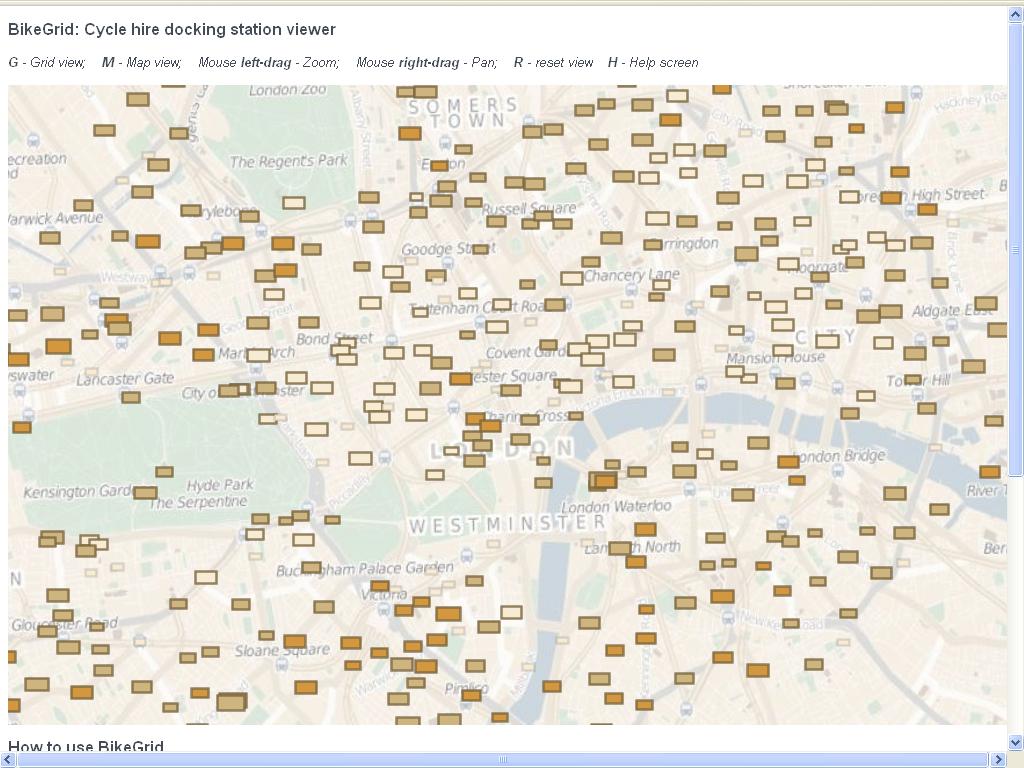
London's bike hire scheme - Barclays bike hire - have a website that gives real-time information on the availability of bikes/spaces at the different stations all across London. The first thing that struck me was the number of hire stations and bicycles scattered around central London. Quite incredible.

It is a little difficult to use at first but once you get the hang of it, it provides interesting information on the use of the scheme. If you go to the grid view - press G and the map morphs into a grid - you can zoom into each station and see what the use has been over the last 24 hours and how many bikes are there right now.
It is interesting to see how many stations have very strong fluctuations in use (like Hyde Park corner below) while others see limited use (like Knightsbridge). The timing in the peaks is also interesting and would appear to show the main direction in flows.
There is a wealth of information on how people move in the city that these bikeshare schemes can gather. I am sure there are a few doctoral theses that you could do on transport planning in inner cities using the information.

Brisbane's CityCycle scheme and Melbourne's Bike share scheme have real time maps (CityCycle map here, Melbourne map here) where you can get information on the number of bicycles or spaces available at any station. They don't give a history of use though so it is impossible to see a history of usage.

Interestingly the information in the CityCycle web site has a field 'credit cards accepted'. All the stations currently indicate that no credit cards are accepted, but this possibly points to this being a feature that can be added.

Wednesday, October 20, 2010

Pedi Cabs


On weekends you cannot help but notice them around Brisbane. Greencabs are quite a feature around Southbank and the city on weekends, and even during the week now. The Brisbane Times reports that the business has been a success since launching in 2009. Greencabs now run 12 pedicabs on weekends and they now have their own marked cab-ranks near the Treasury Casino and at the top of the Mall.

Pedicabs are popping up worldwide as people embrace 'green' transport and realise that, for short trips, a bicycle delivers competitive journey times. The manufacturer, Main Street Pedicabs, has a blog that gives an idea of how widely pedicabs and bicycle culture have spread in the USA. There are a couple of other pedicab setups in Australia that came up in a Google search - Cairns and Sydney . The international Bicycle Fund has a directory of pedicab and rickshaw companies.
Sydney's fantastically futuristic pedicabs

Saturday, October 16, 2010

Melbourne's helmet vending machines

Photo source: article by J Williams

Melbourne has just launched a 3 month trial of a helmet vending machine at two of their bike share station. It is hoped that this will allow more people to use the scheme on a whim. Lets hope this is successful in attracting more people to the scheme. More details can be found here in an article and video by The Age. At a cost of $5 with $3 refund on return to a 7-Eleven they are a bargain. I suspect the vending machines will be the source of helmets for more than just the users of the bike share scheme. Not a bad thing in itself.

Since May the scheme has been used for 20,700 trips. That equates to less than 175 trips per day. They are doing a bit of a marketing push to get more users on the bikes in spring, giving away a $1,000 resort voucher for people joining the scheme.

The scheme is far more focused on casual users than Brisbane's as can be seen in their pricing and the ability to sign up using your credit card at a vending machine. To use Brisbane's scheme on a whim you have to plan at least a week in advance and sign up via the Internet, eventually getting your card after a week or so. Once you have the card you can have daily use at any time. The cost of daily hire and the forward planning required makes it very unattractive for occasional users and largely inaccessible to tourists. I assume this was intentional so as not to impinge on existing bicycle hire businesses aimed at the tourist trade.


Daily

Weekly

Brisbane CityCycle

$11

Not available

Melbourne Bikeshare

$2.50

$8


It will be interesting comparing the two schemes after a year to see which model has been most successful in attracting users, and what the user profile is.

Sunday, September 19, 2010

CityCycle dreaming

I dreamed the other night that I hired one a CityCycle bike to go to a lunch appointment in the West End. It was great except there was no parking when I got there. The restaurant had hidden the cycle racks under some tables. So How very disappointing. Lets hope that does not happen in reality. It would seem highly unlikely considering the number of docking stations being rolled out all over the city and West End. See the map here.

It is exciting seeing all the cycle hire stations getting the finishing touches around the city. I was so excited I asked our 'green team' at work whether the company were going to take out corporate membership of CityCycle. The response was disappointing, but not surprising - the health and safety policy would not allow it because the risks are just too high. Experienced cyclists are encouraged to use the scheme but the lack of safe cycling facilities in the CBD means the risk for inexperienced cyclists is too great.

I suspect many company health and safety committees will come to the same conclusion. It will take a lot to change the perception that cycling is dangerous. Interesting statistics from the Netherlands is that walking is actually more dangerous than cycling. The fatality rate for pedestrians is far higher (per billion kilometers travelled) than cycling is. And both are more dangerous than driving, being above the average for all modes. Here are the numbers for the years 1999-2003.

Pedestrians 32 deaths/billion km
Cyclists 14 deaths/billion km
Car drivers 4 deaths/billion km
All modes 6 deaths/billion km

From these statistics it would appear advisable for health and safety committeesto advise people against walking and cycling and encourage people to drive more. But public transport is even safer as these statistics from the UK show. Interesting to see how much safer it is for cyclists and pedestrians in the Netherlands.

Passenger death rates per billion passenger kilometres


1993 1997 2001 2002
Motorcycle 106.0 119.0 112.3 111.3
Walk 70.1 57.6 47.7 44.8
Bicycle 46.5 44.9 32.7 29.5
Car 3.2 3.1 2.9 2.8
Van 1.6 1.0 0.9 1.0


Bus or coach 0.7 0.3 0.2 0.4
Rail2 0.4 0.5 0.2 0.3
Water3 0.0 0.0 0.4 0.0
Air3 0.0 0.0 0.0 0.0

Saturday, February 27, 2010

Bicycle Boulevard Guidebook


A new guidebook has been published out of Portland, Oregon on designs and treatments for Bicycle Boulevards. Bicycle Boulevards
are low-volume and low-speed streets that have been optimised for bicycle travel through treatments such as traffic calming and traffic reduction, signage and pavement markings, and intersection crossing treatments. These treatments allow though movements for cyclists while discouraging similar through trips by non-local motorised traffic.
A link to the guidebook can be found below.


Bike Boulevards have been extremely successful in Portland and other North American cities, most of which are relatively flat and have strong grid road networks. Creating a network of Bike Boulevards can be more challenging in cities like Brisbane where few roads provide the connectivity both cyclists and motorists need.

Fortunately, non-grid networks can provide hidden opportunities for Bike Boulevards. For example, no through roads can be connected with bicycle-only pathways. And since many of these roads already feature low traffic volumes, simply improving wayfinding and some intersection crossing treatments may be all that is needed to get cyclists moving.

Sunday, February 7, 2010

Bribane bike hire

Brisbane has called for tenders for the construction of the first 150 bicycle hire parking stations as reported in the Brisbane Times. Councillor Sutton has a valid question as to where cyclists will be able to ride. The paucity of safe cycle facilities in the CBD and Fortitude Valley is a major deterrent to potential cyclists, not to mention the need to wear a helmet.

There is huge potential for providing cycleways similar to the one in George Street on several of our city streets. Elizabeth Street and the lower end of Queen Street would make a great link across the CBD, a safe shortcut across the city. Linking to the pathways along the river would need some clever planning.
Linking the new cycle centre in Roma Street to Albert Street through the Mall would be good but the number of pedestrians would make it difficult to safely cycle through the mall. The Malls Act prevents cyclists using this section - a huge pity. The taxi parking would need to be moved to make this possible.
Continuing the cycleway along George Street would be fantastic but would need some clever traffic management and the poor taxis will get moved on again.

These are just idle ramblings on a Sunday afternoon. Anyone else out there with dreams for a network of cycleways through the city?


Sunday, January 10, 2010

Brisbane Cycle Centre

The Brisbane City Council has undertaken an assessment of the performance of the Cycle Centre located in the King George Square Bus Station. The assessment included a survey of current users of the facility. They have not published the report on-line but the Brisbane Times has a good article on it.

The Cycle Centre is owned by the Council but operated by Cycle2City. The photos are from their web site where they also have a video tour of the facility.

The main concern of the report is the slow growth in membership. At the time the research was done (June 2009) the centre was only at 50% capacity of the 420 spaces available. I popped in there a week ago to get stuff from the cycle workshop and they said they were around 75% full now. For the first week back after New Year I was impressed by how busy it was.Some of the reasons cited for the slow growth in membership were
  • location: the centre is far from the main business centre of the city and around a third of members have to walk or catch a bus over 800m from the centre to their places of employment. Including a second Cycle Centre as part of a future Cross River Rail station in the Riverside precinct would be good. Although the Roma Street precinct is set rapidly growing the new buildings are all most likely to have their own cycle facilities for staff and so the need for the centre is reduced.
  • Fee structure: At $4 a day for a 6 month membership or $8 for casual use ($5 to just park the bike) the cost puts many off using the facility. Reading the comments at the end of the article are interesting as cost seems to be the main reason many don't use the facility. Yet current users are happy that the cost is less than public transport and includes secure parking, a locker, shower and towel it is too expensive for many.
  • Marketing: The report highlights poor marketing as a reason for the slow growth and the managers admit they took time to realise people would not just walk in the door. From a discussion with the manager six months ago I learned that one of their big marketing coups was approaching businesses instead of individuals. Approaching business without their own cycle facilities to buy memberships for their staff brought in quite a few new memberships. Businesses wanting better 'green' credentials but constrained by their facilities were willing to buy into this. Being located in an older part of the city where most buildings don't have end of trip facilities for cyclists would be good.
The Cycle Centre may have taken a bit of time to get going but I would hesitate to call it a white elephant (one of the comments on the news article). Although growth in membership may be slow there is further growth potential as the Roma Street precinct grows and improved cycle facilities are provided through the city. Within 5 years there will probably be a need for a second Cycle Centre in the city.

Brisbane's second Cycle Centre has now opened at the Royal Brisbane and Women's Hospital busway station serving a very different market. It will be interesting to see how it performs over the next 12 months.

Wednesday, December 9, 2009

Kurilpa Bridge comments

Walking over the Kurilpa Bridge on the way to the PBT end of year function we all discussed the great and problematic elements in the design for pedestrians and cyclists. Much like the Goodwill bridge, the bridge operates as a shared pathway with recommendation that cyclists keep right and pedestrians keep left. This works well and reduces the likelihood of cyclists becoming aggressive towards pedestrians being in 'their area' as happens where they are separated.

Instead of using painted lines down the centre of the bridge to separate the directions of travel the architects used different shades of concrete. This looks good, works well and is low maintenance. The photo does not show this as clearly as in real life.
The use of separated bi-directional cycle lanes along one-way Tank Street and George Street is excellent. What is odd though is that a 0.5 m wide raised kerb is provided on Tank Street where the traffic speeds and volumes are low, but a small removable barrier was used on George Street where traffic speeds and volumes are high. This results in wasted space on Tank Street where additional footpath width would have been beneficial.
As can be seen in the photos above and below there is a lot of pedestrian movement across Tank Street. Unfortunately there is no provision for a pedestrian crossing point between the bridge and the intersection with George Street. The traffic speeds and volumes are low but this arrangement is not ideal. Pedestrians tend to treat the area as a shared zone and it would have been preferable if the area was designed as a shared zone.
As can be seen above there is no pedestrian pathway for people wanting to walk back towards North Quay and so people walk through the flower beds.
There is a very odd arrangement for cyclists travelling down George Street that want to access Tank Street. According to this sign they need to ride on the footpath to cross at the lights. Considering the volume of pedestrian traffic along George Street this is impossible. It is also illogical for cyclists and all stay on the pathway and turn at the lights. The location of the sign is also unfortunate since it has been placed in the path of cyclists who would supposedly use the turning facility. The height of the sign also makes it invisible to cyclists and pedestrians.

A strange raised area is placed on the cycle path at the entrance to Tank Street. It is unclear what the intention of this is. It cannot be meant to slow down cyclists because it is barely noticeable on a bicycle. It is not meant to indicate a shared zone with pedestrians because the pedestrian crossing is ahead of it. Unfortunately the location of the ramp is just where cyclists need to stop to press the crossing button and makes it awkward to stop on an incline and press the button.
The pathway stops at Turbot Street where it quite elegantly funnels cyclists down to the King George Square Cycle Centre. Cyclists wanting to travel further south into the city are unfortunately left stranded on little Roma Street with no clear route south.

The heavy volume of traffic turning from George Street into Turbot Street currently constrains the possibility of extending the pathway further south along George Street. It is unfortunate though that the option to extend this further some time in the future was made difficult by relocating the traffic signal to the new kerb line. If the traffic signal had been left where it was the cost of extending the bike path down George Street in the future could have been significantly reduced. In planning for this type of facility we need to ensure that we allow for the easy expansion of the system in the future when the current traffic constraints may be changed.

The discussion of the Kurilpa side of the bridge found far fewer issues. The limited space and height of the bridge meant that the bridge makes a leisurely spiral down to the ground. Although very elegantly done it does make for a less direct pedestrian route. Providing the option of stairs could have provided a slightly more direct route for pedestrians but would probably have destroyed the elegant lines of the bridge.

The entrance to the bridge is narrowed by a low wall in the right of the photo above. Although not a major issue with the current volume of pedestrians and cyclists it may cause a bottleneck as volumes increase.

Tuesday, December 8, 2009

End of year event

On Thursday 26 November we had the Pedbiketrans AGM and end of year function. The AGM was held in the BCC community room in the library and dinner was at the Forest in the West End. The food was excellent vegan fare, the beers were free, the conversation was engaging, and the background music was incredible. I am now a fan of double base trance music.

To get from the library to the West End we walked over the new Kurilpa Bridge. Love or hate the architecture, it is a useful little link across the river. The bridge was designed by Cox Rayner Architects with Arup and constructed by Baulderstone.
The bridge is 6m wide shared pedestrian and cycle bridge. It is pleasant to walk or cycle across and forms an important link in the active transport network. The view of the city with the bridge in the foreground is a favourite with photographers and you are sure to see a few with tripods and fancy cameras at dusk. According to the Eco Architecture blog the bridge lighting is 100% solar powered and it is the world's largest solar powered footbridge. Later on in the week I will post some of the discussion the PBT team had on the weaknesses in the design for cyclists and pedestrians.

Thursday, June 25, 2009

Active transport news from Brisbane

PBT held a seminar on 18 June where the Brisbane City Council provided an update on their Active Transport Program.
Bryony Chapman, Project Manager for the CityCycle project gave an excellent presentation on the City's bicycle hire scheme. Lyndal Peters, the team leader for Travel Behaviour Change gave a presentation on the program and Stephanie Edwards, a program officer for cyclist and pedestrian mobility, gave an update on the progress of the Bikeways investment program. Unfortunately I cannot include the presentations but here are some highlights from the presentation on the CityCycle scheme.

The picture above shows an artists impression of what a CityCycle bicycle hire station may look like. The BCC web site provides some background information on the scheme. The successful tenderer providing the Brisbane scheme is JCDecaux. You can read about their Cyclocity bike hire stations here.

The target for implementing the scheme is to have up to 1,500 bikes and 81 bike hire stations in the CBD and Fortitude Valley by mid 2010. By mid 2011 a further 500 bikes would be rolled out and a total of 150 bike hire stations would be dotted in strategic locations around the CBD, the Valley, West End and Newstead.