Showing posts with label New South Wales. Show all posts

Tuesday, November 22, 2011

Faster by bike?

The RTA recently published their travel time survey results for 2011. With only a small minority of roads operating with average speeds of less than 20km/h you would be hard pressed to beat the average speed you could achieve in a car. Only Cleveland Street, parts of Parramatta Road, O'Riordan Street, Old South Head Road and Oxford Street are average travel speeds less than 20km/h. Considering that this includes stops you may be hard-pressed to beating the traffic on a bike.

South East Queensland's 2009 Travel Time Survey shows much the same picture with around 65% of the major arterial roads in Brisbane travelling with average speeds greater than 25km/h. With the Gold Coast and Sunshine Coast having 90% and 97% of average speeds on arterials greater than 25% there is even less likelihood of beating cars on longer journeys.

Ten News did a short news report on a race they did between a cyclist and car from east Brisbane to King George Square. On the 5km race the bicycles beat the car by a mere 2 minutes during the morning peak hour. Not much of a time advantage but at least the cyclists burned some fat during the commute and didn't have to pay for parking or fuel. As the cyclists said, they could also be certain that their travel time would be reliable, something impossible for the cars to predict.

So will congestion be forcing people to start cycling? Probably not unless it gets far worse than it currently is and there is scant chance of that happening as it will have serious economic consequences for Brisbane. The best way to get people to choose active transport is therefore to make it attractive (safe and pleasant), convenient (lockers, showers and parking) and make car travel more expensive (charge for long term parking).

Monday, July 18, 2011

Bike Bulletin


The New South Wales government's NSW BikePlan can be found here along with the reports from several interesting research projects including the cost and benefit of cycling related investments, barriers to cycling in NSW, bicycle parking at rail stations, and an analysis of the available data related to cycling.

To keep the public up-to-date with the delivery of the plan they are publishing the Bike Bulletin. This report on how they are delivering the plan. It would be great if the Bulletin also gave some information on usage of these facilities before and after the investment.

Saturday, February 12, 2011

Sydney seperated bike lanes


I was down in Sydney at the end of this week and so I took a morning jog to see the separated cycleways the city has built. It was good seeing what I had read so much about.
The first thing I noticed was that Sydney-siders get up far later than us Queenslanders. The cycleways were empty at 7:30am and most cyclists I saw were in general traffic. I was starting to wonder whether the cycleways were in the right place because at that time of the morning Brisbane's bikeways are packed.

But by 8am the cycleways were filled with riders. The cycleway along College Street was very busy and cyclists coming up the hill spread over the whole bi-directional cycleway. Fortunately the flow appears very tidal so there was no conflict.

It was good to see how Sydney has tried several different designs.
There are the standard kerbside bike lanes.
shared bus lanes (which are the bane of bus passengers who hate travelling at bicycle speeds)
shared pathways

separated bike lanes on the road pavement
and separated bike lanes at the footpath level.
Lots of style out there on the bikes - no wonder there is now a Sydney Cycle Chic web site.
There are some good points and some things that do not appear to work well. But more of that in my next post.

Wednesday, October 20, 2010

My bike route

Sydney is trialing an interesting website to get information from users on the bikeable or potentially bikeable network. They are asking cyclists to tell them what routes they would recommend as cycle routes that are currently not marked as such. An excellent initiative if sufficient response can be achieved.

Brisbane is developing a bicycle route mapping system based on the Google Maps. It is not live yet but I am looking forward to it being up and running. Far better than the old static maps.

Tuesday, May 18, 2010

Looking after pedestrians and cyclists in Sydney

Sydney has embraced bicycles and pedestrians. The City is spending $76 million over the next 4 years on rolling out 200km of cycleways in Sydney. Part of the investment is to improve the lot of cyclists in the CBD. To improve the permeability of the one-way road system and to improve safety for cyclists they are delivering a number of separated bi-directional cycleways through closing curbside lanes.
This photo of King Street (from the Council web site) shows the type of facility. The maps below show some of the CBD cycleway links they are building.


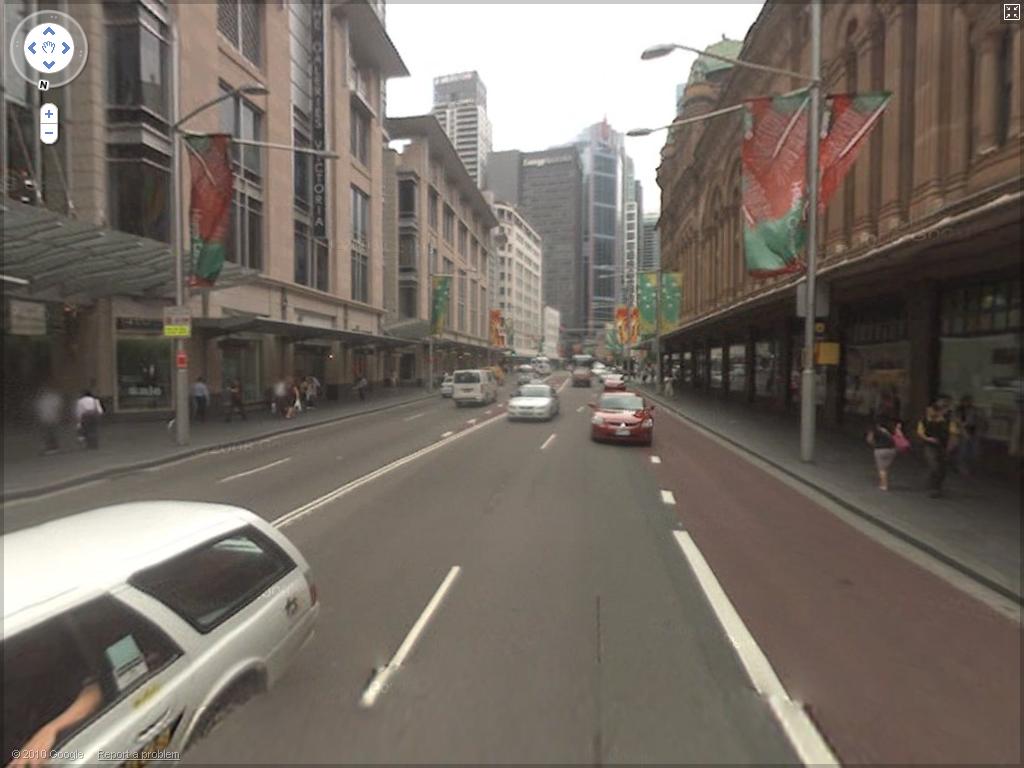
The ABC reports that Council is considering restricting vehicle access to George Street between Bathurst and Market Streets to just taxis and buses, rolling out a 40kph speed limit throughout the City. These are part of the recommendations of Gehl Architects which recommended a more holistic mindset of traffic and public space planning that looks after pedestrians and cyclists and improves the visual amenity of the City. Anyone who has walked up George Street from would agree with that. This shot from Google Streetview of George St shows why it would not win any awards for people friendly design.
I look forward to doing a tour of these projects in my next visit to Sydney.

Monday, February 22, 2010

Weekend training cycle

The Saturday morning training ride just got a little safer in Sydney when Kingston Council approved a 12 month trial of no-standing restrictions on one of the most popular cycling circuits on Saturday mornings. An article in The Age gives the details.

The media has been full of articles recently that accuse cyclists of being a lawless bunch. It is good to hear of measures being taken to make the sports cyclists lot a bit safer. Creating safe sports cycling routes on weekends would be an excellent initiative to reduce the risk.

The city of Durban in South Africa reserves one lane of the main arterial into the city from the north (NMR Avenue) for cyclists on weekends. It is a popular training route running parallel to the beach and has had several deaths.

In 2009 New York City closed city streets on three consecutive Saturday mornings and gave them to cyclists, joggers and impromptu markets. It was called Summer Streets and was a huge success. They are doing it again in 2010 because of the popularity. Wouldn't it be great to try something like this in Brisbane as part of Bike Week?

Monday, November 2, 2009

Sydney Harbour Bridge picnic

On Sunday 25 October 2009 the Sydney Harbour Bridge was closed to traffic for the morning to hold a massive picnic. The event was organised by the NSW government as part of their spring festival. Just 6,000 people were chosen by lottery to join the picnic.

The ABC news site (where I got the picture) gives a short report and an excellent time lapse video showing from start to finish.

Although just a small event the message this sort of event sends out is great - the car is not king, roads can be closed for people.

Friday, September 4, 2009

Bicycle parking at stations


PB is assisting the NSW government with research to inform the new NSW BikePlan. The reports have recently been published on line here. The first element of research looked at existing data on cycling to inform the development of the new NSW BikePlan. It highlighted several gaps in the data but, as I am sure we have all experienced, the lack of consolidated data sources on cycling was highlighted as a major constraint to effective policy and planning. There is an urgent need to create a single electronic library of this information.

PB did some interesting research on existing levels of cycling to public transport interchanges. The study found that cycling extends the catchment of public transport interchanges to approximately 5 - 7 km. The audit of bicycle parking found that the majority of the bicycles were parked informally (chained to fences and railings).

Surveys of cyclists parking at the stations showed that the main reasons to cycle to the station were that it is the quickest and easiest mode. Health and fitness was similar in popularity. A lack of parking and a lack of access to a car were cited by less than 10% of respondents as their reason for cycling.