Showing posts with label Resources. Show all posts

Monday, June 4, 2018

Four types of potential bicycle riders

I think most of us have come across the research undertaken by Roger Geller on the four types of transportation cyclists in Portland, Oregon. I have seen it referenced in multiple reports, but have also heard many questions about its applicability across geographies.

Recently I came across some research undertaken under the Transportation Research Board in the USA that aimed to expand the model to assess other cities in the USA. You can purchase the research report by Jennifer Dill on the TRB site here. I found this very useful slide presentation from 2015 on the LinkedIn Slideshare that summarises the outcomes of the research report.


Four Types of Cyclists: A National Look from TREC at PSU

Now  we just need some similar research in Australian cities. I am quite certain that the Australian population will have a similar profile of potential bicycle riders, but local research is always more pwerful to reference.

Thursday, March 9, 2017

Trends in cycling - a little old, but good

This interactive web page developed by Allianz is a great resource summarising some of the census and other data sources on cycling.

https://www.allianz.com.au/life-insurance/news/cycling-in-australia

Good on you Allianz for doing your bit to provide information and promote cycling.

It would be great if all cities and states provided this sort of update on an annual basis. It provides a fantastic barometer on how we are doing in supporting active transport.

Portland, Oregon regularly publishes a short report on cycling in the city on key corridors. It provides a great snap shot of cycling trends in the city. The National Cycling Participation Survey is great, but the information could be presented in a far more accessible format than a PDF report.

Tuesday, August 18, 2015

Active cities

The Transportation Research Board (USA) recently issued a guide for city leaders on improving how cities support active lifestyles. I love the way the USA makes guidelines, statistics and research publicly available for free. They have some brilliant resources. Although they tend to be focused on the USA they are often more applicable in Australia than similar European research and guidance.

I love this quote from the report:
'Cities that make physical activity a priority, convert existing spaces into active spaces, and design environments for people to be active will create a legacy of physical activity. These active cities will be better off by almost every possible measure.'
The report has some great statistics and info-graphics. Not all the research is from the USA as the guideline is aiming to show a broad base of evidence of the benefits of active cities. In fact Adelaide is mentioned as an example of a city that is doing well at supporting activity.

The guideline gives simple and practical advice on supporting the development of an active city related to:
  • open spaces and parks
  • urban design and land use
  • transport
  • schools
  • building design and work spaces
It then gives policy interventions that will deliver positive outcomes - including 'quick wins'. And then it also provides links to a wealth of tools and resources. This guideline is a valuable resource that is aimed at the non-technical leader / decision makers in cities. It would be good to get more awareness of it amongst transport planning professionals and public figures.

Brisbane is doing many of these interventions and that is one of the reasons I love living here. Wouldn't it be great if these principles could be completely embraced by our cities.  

Monday, August 3, 2015

Economic benefits of active transport

The U.S. Department of Transportation recently published a white paper on evaluating the economic benefits of non-motorised transport. It provides a short review of available economic analysis tools, and recommendations on how they may be used. The comparison table of tools in Appendix A provides a useful comparison of what the tools can tell you, their data needs and usefulness.

Although it is a very brief paper, it provides an extensive list of reference works that provide some interesting data snippets from the USA and the UK.

Some interesting snippets of facts cited in the report:

Project specific economic benefits in New York:

  • 49% increase in retail sales near the protected bike lanes on 8th and 9th Avenues in Manhattan (compared to a 3% increase borough-wide)
  • 49% fewer commercial vacancies near the reconfigured pedestrian plaza at Union Square North (compared to 5% more borough-wide)
  • 172% increase in retail sales at Pearl Street in Brooklyn, where an underused parking area was converted to a pedestrian plaza (compared to an 18% increase borough-wide).
  • 58% decrease in injuries to all street users on 9th Avenue in Manhattan where a protected bike lane was installed
Macro-economic benefits: Vermont
  • Vermont hosted over 40 running and cycling events in 2009, which attracted over 16,000 participants spending over $6 million in the state. The running- and cycling-related spending from these events supported an estimated 160 workers;
  • A business survey found that bicycle- and pedestrian-oriented businesses in Vermont generated $37.8 million in output and directly employed 820 workers with $18.0 million in labor earnings

Wednesday, July 1, 2015

People are driving less

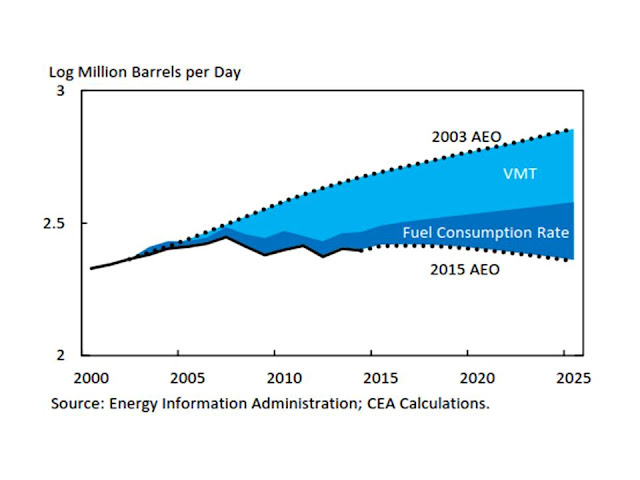
The US has just released an interesting report on the surprising reduction in fuel consumption that has been observed since 2005. This is contrary to the models that predicted in 2003 that there would be a significant increase in fuel consumption due to increasing economic conditions in the USA. The data shows that the bulk of the reduced fuel use is due to people driving less (see below from the report).
This trend is despite increasing real disposable income per capita, shown in the figure below from the report.

The report notes that there is limited research to explain this 'surprise'. Some potential reasons given include:

  • an aging population drives less
  • 'millennials' drive later and less
  • the internet is reducing the need to drive
  • the real cost of fuel has risen in the USA
Interestingly, there was no mention of how supportive land use, improved public transport or active transport infrastructure may be contributing to the reduced need for people to drive a car.

Friday, December 5, 2014

Innovation in Queensland

On a recently completed project we consulted with a number of municipalities on the factors that prevent them from delivering cost effective improvements to cycle facilities. One of the biggest barriers cited was the reticence of municipal engineers to sign off on non-standard or 'innovative' designs for active transport facilities. I include the inverted commas as the treatments are often quite commonly used internationally or in Australian cities. They just have not been used in that specific municipality.

Major stumbling blocks to getting approval of designs include:
  • not aligning with the engineers interpretation of recommended standards set out in Austroads guidelines
  • lack of clear (or any) guidance in Austroads on the treatment proposed
  • lack of willingness to be the first to try something that may be commonly used elsewhere
There is fundamentally a philosophical conflict that occurs where one side argues that:
  • No cycle facility should be provided unless it is of the highest standard
while the other side argues that:
  • some form of cycle provision is better than none, so long as it is safe
I would like the world to aspire to the former sentiment. However, I am a realist and I recognize that limited budgets often wont stretch far enough to deliver the best facility. So instead, I support providing a safe facility now (even if not the best solution), with aspirations for allowing for a better solution in the future.

Four resources are available to provide ammunition in the fight to get 'innovative' or non-standard designs approved in the face of risk averse approval authorities:

  • Separated Cycleways Guideline (Department of Transport and Main Roads) - I posted on this previously
  • Guidelines for Road Design in Brownfield Sites is a TMR guideline and includes standards for minimum provision for cyclists as part of road upgrades in constrained environments
  • The TMR policy on engineering innovation  sets out how to go about getting approvals for non-standard or innovative treatments
  • The team of technical officers for pedestrian and cycling facilities in TMR's Engineering and Technology Branch can be a strong ally that could lend the required support to allow an engineer to approve an innovation or non-standard solution.

Tuesday, April 22, 2014

Separated Cycleways

Separated Cycleways are very effective in providing a riding environment in the road corridor where most people feel comfortable to cycle in. They have often been called 'Copenhagen Bike Lines' as they are relatively popular in that city. They are gaining popularity worldwide and also in Australia.

Here is Brisbane's first separated cycleway along George Street.
I have previously written about them in Sydney, Victoria, Copenhagen and New York.

Here is a less than successful treatment for cyclists in New York.


Up till now there has been very little local guidance on appropriate design treatments. That has now changed here in Queensland. The Department of Transport and Main Roads (QLD) have published their Separated Cycleways guideline on their Traffic and Road Use Management (TRUM) web page. Here are some words on it from Jonathan Giles' publicity email:


The Department of Transport and Main Roads aims to provide a direct, safe and comfortable cycle network for people of all ages and abilities to achieve a doubling of bicycle trips for transport.
The Separated Cycleways Guideline presents design guidance supporting the Austroads guides with supplementary advice for bicycle infrastructure including intersections where bicycles are physically separated from vehicles. Facilities like these have been shown to improve safety and increase the ridership of a wide cross section of the community.
This guideline is intended to assist designers, engineers and planners with options on appropriate bicycle facility type for principal cycle network or local routes. Construction and whole of life maintenance considerations are also included. It is acknowledged that in many situations optimal solutions may not be practicable.

The Separated Cycleways Guideline has been prepared to support TMR’s Cycling Infrastructure Policy and Queensland Cycle Strategy 2011-2021 and to provide additional guidance to local and state government and industry. The new guideline is an 'approved notice' of the TORUM Act. It is listed under interim notes until the next formal amendment.
Join us for our 2 May 2014 seminar and webinar to hear more about the guideline and provide feed back.  PedBikeTrans in conjunction with Bicycle Queensland will be hosting the seminar (and webinar) introducing the new guidance and discussing the new intersection design guidance in detail. Please RSVP at:
http://2may2014pbt.eventbrite.com

Wednesday, March 26, 2014

Research resources

The Transportation Research Board in the USA have a resource of pedestrian and cyclist related research. It is largely very dry and technical but has interesting research and is worthwhile keeping on file as a resource.


Tuesday, January 28, 2014

Crash data available on line

Government's open data policy is making access to crash data far easier. Have a look at the website to see what else is or will soon be available from the Department of Transport and other government agencies. I played with the crash data and was quite horrified to see the carnage that occurs on our road network.

There is lots of data on crashes involving pedestrians and cyclists and any number of different ways to cut it. Here is a graph I put together summarising the fatalities and hospitalisations of cyclists over the last 10 years split by TMR regions.

As you would expect, the Metropolitan Region has the highest number of fatalities and hospitalisations. What would be interesting to cross-correlate this data with population and/or cycling activity levels.

The data from TMR includes the traffic census on state controlled roads for 2012 but unfortunately does not include the count data for bicycles that TMR previously placed on the 131940 web site. It would be great if the historical count data from their cycle monitoring stations could also be released as it was previously.

Saturday, July 7, 2012

City Cycling

John Putcher and Ron Buehler have edited a new book - City Cycling - that provides 'a guide to today's urban cycling renaissance, with information on cycling's health benefits, safety, bikes and equipment, bike lanes, bike sharing and other topics'. City Press has more details here: http://citycyclingbook.wordpress.com/

The table of contents looks interesting with contributions from several experts. I am sure it would be a good read. It came to my attention in an email on the emerging trend to choose style over speed with cycling, and the move to get separation of cyclists from traffic.

His response to the latter was excellent and he noted the complexity of the issue of separated cycle lanes. As with anything, separated cycle lanes are not the solution to every problem and a multi-faceted approach to providing for cyclists is required to respond to the wide range of needs of different categories of cyclists and their trip purposes.

I invite the first person to read this book to write a review for this blog.

Friday, July 6, 2012

Children and cycling

The European Cyclists Federation have an excellent article on supporting more children cycling. It points to the Netherlands as an example where more children cycle to school than walk. This is in contrast with all other European countries where more children walk to school. In the USA only 1% of children cycle to school and Australia does not fare much better.

So why don't more children cycle to school? The ECF article identifies 3 things that the Netherlands has implemented that appear to be a recipe for success:
  • Child education and training - school children get educated and have practical on-road training in safe cycling and walking on the road network
  • Safe infrastructure - a cohesive and continuous network of cycle facilities that separate cyclists from traffic is essential to getting more children cycling to school
  • Driver training and legal responsibility - driver training emphasises the responsibility of the driver to be aware of pedestrians and cyclists. If a child cyclists or pedestrian is hit by a car the legal responsibility is almost automatically placed on the car driver.
This excellent blog post by Jan Garrard identifies some of the constraints to more children cycling to school. These are:
  • trip distance, which is supposedly greater in Australia
  • traffic hazards
  • “stranger danger”
  • the inconvenience of cycling compared to being driven.

  • Infrastructure improvements will only address one of these constraints. Our urban structure will be difficult to address. Parental fear and laziness can be addressed through education and encouragement.

    Unfortunately I believe that the shift of Grade 7 to high school will further reduce the number of children walking and cycling to school in Queensland as it impacts most severely on the first of these factors.

    My two children (5 and 7 years old) have just started riding and we have had great fun cycling along the cycle paths in Brisbane and surrounds on weekends. But will they cycle to school? Probably not to primary school as the school is at the top of a big hill less than 600m walk from home. But if they wanted to I don't believe it would be feasible. The school is on a busy intersection with few safe cycle routes. I also have not seen any cycle parking at the school, although I have seen a couple of kids cycling.

    For high school the prospects are better as our local high school is just off the SE Bikeway, as are we. Despite this the school has awful cycle parking that looks barely used. There is much that can be done to improve cycling for school children.

    I suspect (and Jan Garrard would seem to agree) though that the most effective way to get more children cycling to school is to get their parents excited about cycling.

    Monday, February 6, 2012

    BMW Guggenheim Lab

    Rachel Smith was telling me about an exciting project she has the privaledge of being involved in - the BMW Guggenheim Lab. They have a web site, blog and twitter feed.  Here is what it is all about in her own words:
    "Rachel was nominated by Enrique Penalosa the former Mayor of Bogota and international urbanist and selected by the advisory committee and curators of The Solomon R. Guggenheim Foundation in New York. 
    The BMW Guggenheim Lab is a mobile laboratory travelling to 9 cities over 6 years led by international, interdisciplinary teams of emerging talents in urbanism, architecture, technology and sustainability. The Lab addresses issues of contemporary urban life through programs and public discourse. Its goal is the exploration of new ideas, experimentation, and ultimately the creation of forward-thinking solutions for city life. 
    The Lab, designed by Tokyo-based architects Atelier Bow-Wow, is a combination think tank, public forum, and community centre. The theme for Cycle 1: Berlin, New York and Mumbai is ‘Confronting comfort’ aiming to make urban places more responsive to inhabitants needs. Cycle 1 will conclude with an exhibition presented at the Solomon R. Guggenheim Museum in New York in 2013. 
    Rachel’s theme for Lab is ‘Dynamic Connections’ which explores many topics including urban transformation, e-mobility and car sharing, open source crowd sourced transport cartography, place making and collaborative consumption. In addition to developing 11 themes of urban public programming Rachel is working with her three lab team members on an ‘urban installation’ to be launched in Berlin on 23 May 2012. 
    The BMW Guggenheim Lab Berlin Team comprises of
    • José Gómez-Márquez, program director for the Innovations in International Health Initiative at the Massachusetts Institute of Technology;
    • Professor Carlo Ratti, architect and engineer who practices in Italy and directs the SENSEable City Lab at the Massachusetts Institute of Technology;
    • Dr Corinne Rose a Berlin-based artist who works with photography and video and teaches at the Bern University of the Arts
    • Rachel Smith, principal transport planner with AECOM, based in Brisbane, Australia

    Sunday, December 4, 2011

    Walk Score

    Here is a nice little tool to compare the walkability of an address: www.walkscore.com
    The tool uses a simple weighted scoring of distance to amenities such as shops, restaurants, schools, banking etc. to rank how walkable the address is. They have also produced a walkability Heat Map and ranked many US cities.
    The tool is fun to play with but has some major limitations that makes comparing addresses not always that useful. Some of these shortfalls that may give strange results are:
    • walk-score does not appear to include distance to transit and its frequency in its calculations. It has a separate transit accessibility score (where transit agencies make data publicly available) but this is not included in the walk score. I believe this is a major flaw as the ability to access public transport to employment and major service hubs is a large contributing factor to improving the available amenities within 'walking' distance. Although you may use public transport it does reduce car dependence. 
    • Walk score does not include distance to employment opportunities.
    • The application is dependent on information being available on the internet. Because of this the city-edge apartment I owned in Pietermaritzburg scored a lower Walk Score that my current mid-suburban home in Brisbane - because most of the amenities within walking distance of my previous apartment are not captured on the web.
    • the assessment does not take into account what facilities are available for pedestrians. An address along a major road with no pedestrian facilities would score the same as one within similar distances to amenities but with pathways and crossing facilities.

    Monday, October 31, 2011

    Rachel Smith

    Rachel has developed a web site with great articles on cycling all over the world. She seems to be doing a lot of jet-setting around the world lately so keep an eye out for some great stories coming from her. She also has a massive library of photos of cycle infrastructure all over the world so have a look at her site.

    Dutch Cycling Embassy

    Cycling For Everyone from Dutch Cycling Embassy on Vimeo.

    Rachel Smith pointed me towards this fantastic little video about the Dutch Cycling Embassy. It is an initiative of the government in the Netherlands to provide access to their extensive network of cycling resources, research, expertise and experience.

    Wednesday, October 6, 2010

    Melbourne's Albert Street seperated bike lanes

    Bicycle Victoria reports on the separated kerbside bicycle lanes along Albert Street in Melbourne that opened in June to much controversy. The media, the RACV and even some cyclists labeled them as a waste of time and money and many drivers were unsure how to use them with reports of drivers parking in the bike lane during the off-peak, instead of in their parking lane. VicRoads have made improvements to the lane to make it more obvious how to use them, including making the bike lanes green paint and installing flexible guides to dissuade drivers from using the lane - as the picture below shows. It would appear from the picture though that drivers still have difficulty understanding as there appears to be a yellow car parked in the lane in the photo.

    VicRoads recently released a road safety audit of the performance of the bicycle lanes. The audit notes that the treatment is unique in Melbourne (although common elsewhere in the world) and would therefore confuse drivers until they are used to it. The report notes some inherent road safety risks including drivers entering side streets and driveways not being aware of cyclists and the risk of passenger doors and pedestrians stepping into the lane (BV notes that only 10% of cars have passengers so the risk is far less than driver-side bicycle lanes). It does not come to any conclusion as to the safety of the treatment or any measures that could improve the safety.

    Bicycle Victoria has published an overview of international practice in separated bicycle lanes that provides a useful scan of international practice in using these.

    Wednesday, September 29, 2010

    Bicycle Safety

    In the Augusat 2010 issue of the Journal of the Australian College of Road Safety is a special issue dedicated to Bicycling Safety. They have these peer-reviewed papers on safety issues:
    • Crash prediction models and the factors that influence cycle safety
    • Cycling injuries in Australia: Road safety’s blind spot?
    • Child cyclist traffic casualties: The situation in South Australia
    • The effects of bicycle helmet legislation on cycling-related injury
    • Cyclist visibility at night
    • The role of traffic violations in police-reported bicycle crashes in Queensland
    • Painting a designated space: Cyclist and driver compliance at cycling infrastructure at intersections
    They also have the following articles:
    • A note on the central stories of fatal and other cyclist accidents in Adelaide
    • Piloting a Safe Cycle education program
    • Encouraging safer cycling through the NSW BikePlan
    • Cycling safety in the Australian Capital Territory
    • Cycling safety in Victoria
    • The Australian Bicycle Council and the National Cycling Strategy
    • The Amy Gillett Foundation ‘A metre matters’ campaign and other initiatives
    • The politics of cycling and cycling advocacy
    There is lots to read and I have just started but an interesting peer reviewed article is the one on crash prediction models. The graph showing the improved safety due to increased numbers of cyclists is quite well known.
    The reduction in risk as length of cycle lane increases:
    And the reduced risk as speeds reduce:
    Kerbside parking is always a problem for cyclists. It is interesting though that low parking utilisation in the kerbside lane is more dangerous for cyclists than high parking use. This is likely due to the fact that cyclists use the empty lane and then need to enter traffic when there is a parked car. This increases the risk as drivers may not expect them.

    Thursday, September 16, 2010

    Australian vision for Active Transport

    A partnership of five groups from the health, transport and local government sector have launched a policy framework for supporting Active transport. The five groups are: The Australian Local Government Association, Bus Industry Confederation, Cycling Promotion Fund, the National Heart Foundation of Australia and the International Association of Public Transport.

    The policy framework sets out a 9-point plan for supporting an increase in walkning, cycling and public transport. These are:


    1. Develop an integrated national active transport strategy that embraces policy and planning for the major components: walking; cycling; and public transport.
    2. Develop clear and realistic targets for activetransport and physical activity outcomes.
    3. Provide local government authorities with substantial, sustained and targeted funding for active transport.
    4. Support the development and widespread application of Healthy Spaces and Places planning principles.
    5. Encourage active domestic tourism by funding major regional projects such as rail trails, cycleroutes and hiking tracks.
    6. Promote a safe environment for people who choose to walk, cycle or take public transport and review jurisdictional approaches to the legislative protection of vulnerable road users.
    7. Fund social marketing programs to promote the many benefits of walking and cycling for people of all ages.
    8. Support cycle training and pedestrian education in schools.
    9. Provide incentives for employers to encourage employees to walk, cycle or take public transport to work.
    The details of the policy framework can be found here.

    Monday, April 5, 2010

    Buffered bike lanes

    Check out this fantastic video produced to educate the public about Portland, Oregon's installation of buffered bike lanes, something used quite extensively in New York (thanks to Peter Berkeley for sharing this link on Facebook).

    On the Right Track from Mayor Sam Adams on Vimeo.


    Here is a picture of a buffered bike lane in New York showing what it should not be used for. Note the potholes and drainage grate - they didn't get everything right.

    What I find interesting in the video is the bridge in the background as Mayor Adams talks. It would appear to be a vehicle bridge that has one lane used by cyclists and pedestrians but I see no marking on the road to delineate this. I Googled and found a Streetfilms video on the Bridge - it is Hawthorne Bridge. It is clear in the video that it does have a kerb between the cars and bikes but interestingly no railing. Considering the obvious capacity issues on the ped and cycle section this seems a bit risky.

    The bridge carries 7,200 cyclists per day which is 20% of the traffic on the bridge and it would appear that there are many pedestrians on the bridge too. Any conflict between cyclists or with pedestrians could catapult a cyclist straight into traffic.

    Interesting fact I gleaned from the Streetfilms blog is that the number of cycle commuters in Portland has increased 600% in the last 15 years. If you build it, they will come (as said in the video)


    Saturday, March 6, 2010

    Cycle Resource Centre

    The Australian Bicycle Council maintains the Cycle Resource Centre, a fantastic treasure trove of 'data, information and best practice relating to cycling planning, policy, programs and projects'. The site includes links to resources for:
    • Engineering and planning
    • Education and training
    • Encouragement and promotion
    • Enforcement and road safety
    • Recreation
    • Funding
    • Research